
Trip plan:
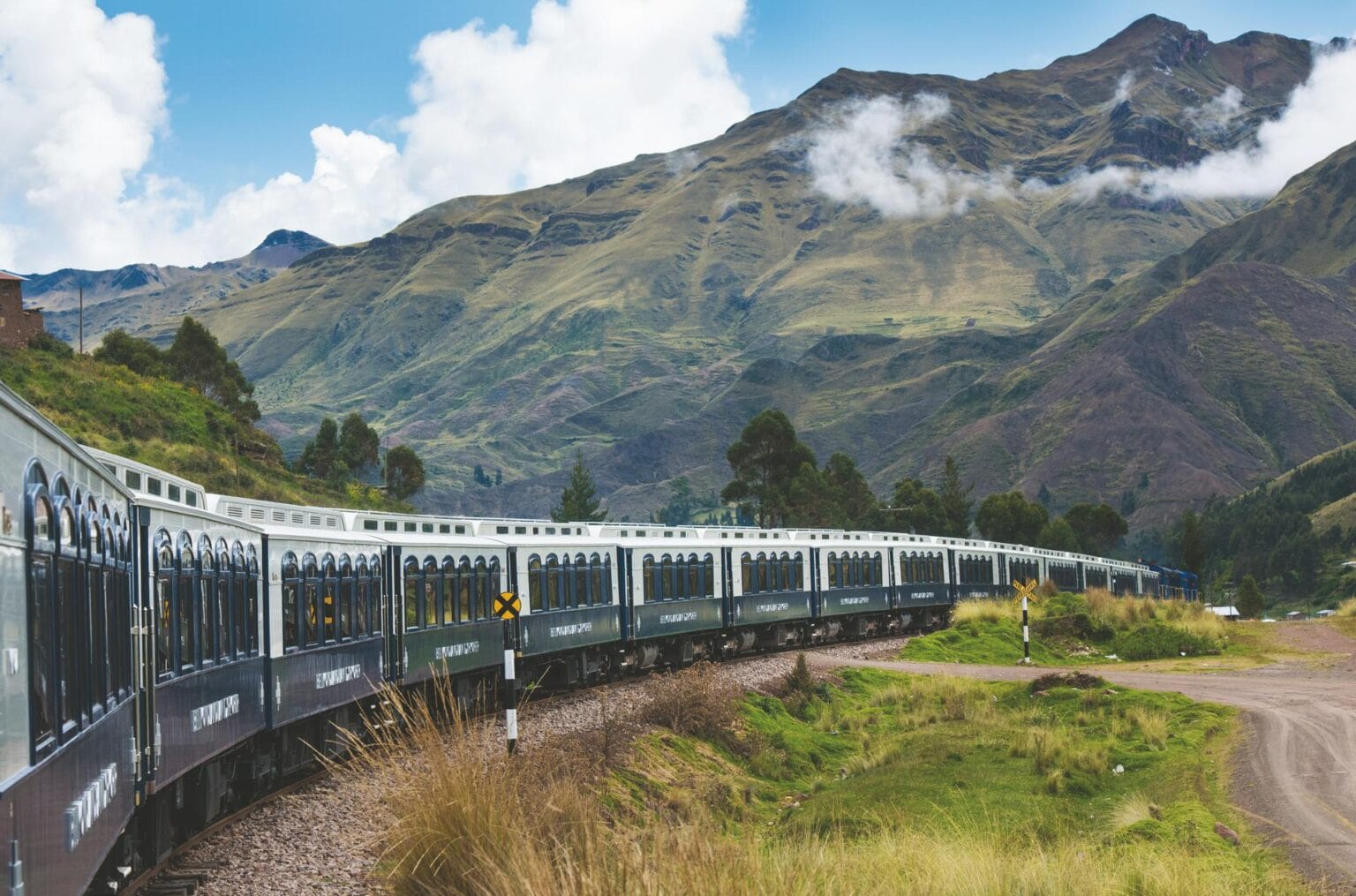
Guests board the luxurious Belmond Andean Explorer train in Cuzco, the ancient capital of the Inca Empire. Once settled in their luxurious compartment, the train will begin its journey southeast towards Puno. Soon they will be invited to their first lunch in one of two elegant dining cars. For lunch, refined Andean specialties are served in a contemporary style.
Shortly thereafter, the train reaches Raqch'i, an archaeological site that was once a vital checkpoint on the Inca Empire's extensive road network. It is situated in a valley known for its Inca cult sites. Most of the Inca buildings are surrounded by a 4-kilometer long defensive wall, but just beyond it, on the Inca road to Cuzco, there is a group of 8 rectangular buildings around a large courtyard - it was probably an inn - tampu, offering accommodation to former travelers. The Raqch'i complex consists of several different areas, each of which appears to have specific functions. Some believe that these buildings may have been intended for religious and administrative officials, while others speculate that the buildings, combined with the scale of the defensive walls, may have been used as barracks for soldiers. Nearby there are about 220 circular buildings called qullqa, probably used as warehouses. Remains of irrigated terraces were found on the nearby hills, which were most likely used for supply qullqa for the needs of travelers. At Raqch'i there is a spring and a pool near the Virakoczy Temple, which may have been used for ritual bathing.
The most important structure of Raqch'i is the Virakoczy Temple, a huge rectangular two-story roofed structure that is 92 m long and 25,5 m wide. The building consists of a central wall of adobe bricks, 18 to 20 m high, built on an andesitic foundation. There are rows of 11 columns on both sides. The foundations of the walls and columns are 4 m high and are made using the classic method of Inca stonemasons. Before its destruction by the Spanish, the temple had the largest single roof in the Inca empire, peaking on the central wall, reaching to columns 25 m distant on each side. The temple's enormous proportions and location explain why the entire Raqch'i complex is sometimes referred to as the Virakocza Temple.
After visiting Raqcha, guests will return to the train in time for tea.
After tea, we invite you to admire the wonderful sunset over the La Raya Mountains, which you can admire either from the deck of the observation car or from the comfort of your own exclusive compartment. The day will end with an elegant dinner on board the train, after which you can spend time in the bar or lounge in the company of other travelers as the train travels to Lake Titicaca, where it will stop for the night.
It's worth getting up early to admire the breathtaking sunrise over Lake Titicaca. We then invite guests to enjoy a delicious breakfast aboard the luxurious Andean Explorer train. After an overnight journey, the guests are bid farewell by the train staff and continue their journey.
Note: We can help you organize a trip to Lake Titicaca, the largest lake in South America. These tours have an additional fee.
Lake Titicaca is located at an altitude of 3812 m above sea level, and its average depth is approximately 160 m. It is 190 km long and 80 km at its widest point. The lake's area is 8372 km². The lake's water level changes periodically by up to 5 meters. The lake is a remnant of an ancient inland sea called Lago Ballivian, which once covered the entire Altiplano. However, unfavorable geological processes and intense evaporation led to a decline in water levels. There are several natural islands on Lake Titicaca (Amantani, Taquile, Suriqui, the Island of the Sun, or Isla del Sol, and over 40 small artificial floating islands - carefully built of woven reeds that are constantly replenished - called Uros, some of which are inhabited by Indian Uro. The latter are worth visiting on board a traditional boat.